
Fabric Supplier Audit Checklist for Enterprise Buyers
"Looking for a trustable full-stack production partner for your clothing fashion brands?Most enterprise buyers look at fa..."
Looking for a trustable full-stack production partner for your clothing fashion brands?
Most enterprise buyers look at fabric suppliers the same way they'd look at a small order vendor: look at the sample, compare prices, and place the order. That method doesn't account for risks that only show up at scale, such as a legal entity that can't be verified, a factory that's been overworked beyond its actual capacity, or a certification that can't be verified when a store clerk or customs officer checks it. This fabric source audit list outlines what enterprise procurement teams should check, how to compare those checks, and how to use a trial order to confirm everything is okay before committing to the full volume.
Quick Answer
A fabric supplier audit for enterprise buyers covers four areas: legal and entity verification, production capacity, quality and compliance documentation, and a trial order to confirm everything holds up in practice. Skipping any one of these is where most large-volume sourcing mistakes originate — not from bad fabric, but from an unverified process behind it.
- Before you send payment, make sure the supplier's legal entity matches the name on the invoice and the bank account.
- Not the supplier's sales pitch, but the size of your actual order should be used to compare production capacity.
- Verify GOTS/OEKO-TEX and social compliance certificates directly through the issuing body.
- Set a written AQL standard and inspection checkpoints before production begins.
- Buy fabric swatches and run a trial order at meaningful volume before scaling to full enterprise production.
Why Fabric Supplier Audits Matter More Than Ever
Visibility holes are common in the sector, so an audit is more important than a good sample. According to 2026 industry data, 95% of garment businesses can't see beyond their direct production partner, 50% can't map their supply chain to the mill, and 35% don't audit subcontractors. Flexible but risky, a garment can involve distinct partners for fabric sourcing, dyeing, printing, garment manufacturing, inspection, and logistics, with no actual checks in place.
For business buyers, finding a quality or compliance gap mid-contract doesn't just affect one package; it can delay the start of an entire season's collection or a store's opening. This is why a structured audit does more than compare prices: it checks whether a supplier can consistently meet your quality, timeline, and compliance needs at the volume you require, not just on a sample.
For a broader view of how global buyers choose reliable fabric suppliers, procurement teams should also assess repeat availability, certifications, MOQ flexibility, and long-term sourcing reliability.
Common Risks of Skipping a Structured Supplier Evaluation
Selecting a supplier without a structured process creates problems that are expensive to fix once production has already started.
- Inconsistent fabric quality across production batches.
- Color variation between sample and bulk production.
- Delayed deliveries affecting seasonal launches.
- Limited production capacity discovered only during peak demand.
- Compliance gaps that surface at customs, not before.
- Hidden costs from rework, replacements, or shipment delays.
When you buy in bulk, even a small mistake can affect thousands of finished clothes, wiping out the cost savings you gained from the cheaper source in the first place.
Start With Legal Entity Verification
A well-designed website or a fast-responding sales contact says nothing about whether the company behind them is who they claim to be — and this is the check most enterprise buyers skip entirely.
Check the supplier's business registration against the applicable national registry and make sure that the legal name matches the invoice and payment bank account. A mismatch—a factory registered under one name with invoicing under a different entity—is one of the most frequent early symptoms of scaled sourcing fraud. Pause the connection, not negotiate.
Check Production Capacity Against Your Actual Order Size
A mill that has never handled your target volume can't scale to meet it without something giving — usually quality, sometimes the ship date, occasionally both.
Find out the factory's monthly production capacity by fabric type, how much of that capacity is being used right now, and the biggest order they've actually filled in the last 12 months. If the number you expect is several times bigger than what they've recently dealt with, you can expect delays or an undisclosed subcontractor. This doesn't always mean they're lying, but there will be a difference between what they say they can do and what they can actually do when they're under real pressure.
Capacity should also be evaluated against the brand's current production stage and expected growth. How to Select a Fashion Manufacturing Partner Based on Your Production Scale provides a useful framework for matching manufacturing capability with order volume and business growth.
Verify Certifications Independently, Not From a Forwarded PDF
For enterprise orders feeding retail or export channels, an unverifiable certificate is functionally equivalent to no certificate — and it's usually only discovered when a shipment is already held at customs. (For a deeper breakdown of what each certification actually covers, see our GOTS & OEKO-TEX compliance guide.)
| Certification | What It Verifies | How to Verify It |
| GOTS | Organic fiber content, supply-chain ethics | Scope Certificate + Transaction Certificate, checked via the issuing body (Control Union, Ecocert, OneCert, Oregon Tilth) |
| OEKO-TEX Standard 100 | Chemical safety of the finished fabric | Certificate number checked via the official Label Check database, matched to product class |
| Social compliance (SMETA/BSCI/WRAP) | Labor conditions, factory safety | Audit report dated within 12 months, from an accredited firm |
| RSL / MRSL conformance | Restricted substances in the finished fabric | Signed conformance statement per batch, backed by accredited lab reports |
Never consider a provided PDF or screenshot as adequate evidence on its own; instead, ask the supplier directly for the certificate number and issuing organization, then independently check it.
Set a Written Quality Standard Before Production Starts
A verbal understanding about "good quality" is unenforceable the moment a dispute happens. A written AQL standard, agreed before production, is not.
In the purchase order, you should include the AQL level, which is usually 2.5 for major defects and 4.0 for minor defects for high-end clothing fabric and 1.0–1.5 for technical or luxury textiles. You should also include who inspects the fabric and when: a sample check before production, an inspection along the line during the run and a final random inspection before shipment. For any sale over a certain volume, it's a good idea to include an independent third-party inspection by a company like SGS, Bureau Veritas, Intertek, or Qima.
Confirm Dye-Lot Consistency for Repeat and Bulk Orders
For any order that spans multiple rolls or dye lots, shade consistency is one of the most common — and most avoidable — points of failure, and it rarely shows up until the fabric is already cut. (We've covered the technical side of this — spectrophotometry, Delta E tolerance, automated color control — in Solving the Consistency Challenge in Large-Scale Fabric Dyeing and Printing.
Ask directly whether the supplier reserves dye lots against your order, what shade tolerance they maintain between lots, and whether they run a lab dip and bulk approval process before production. A supplier without a concrete answer is telling you they don't have a formal system in place.
The Complete Fabric Supplier Audit Checklist for Enterprise Buyers
The ten areas below cover the full sourcing process, not just fabric quality — this is the checklist to work through, point by point, before approving any supplier for bulk production.
1. Company Verification & Business Credentials
Every other point on this list is only worth checking if the business is legally registered, has been in business for a certain number of years, has experience with foreign buyers, and has client references that can be contacted.
2. Manufacturing Infrastructure & Production Capacity
The biggest order that was actually filled in the last 12 months, the monthly capacity by fabric type, and the ability to grow during peak season.
3. Fabric Quality & Technical Standards
GSM consistency testing, as well as shrinking and colourfastness tests. You can get quality reports on request, not just by talking about them.
4. Product Development & Sampling
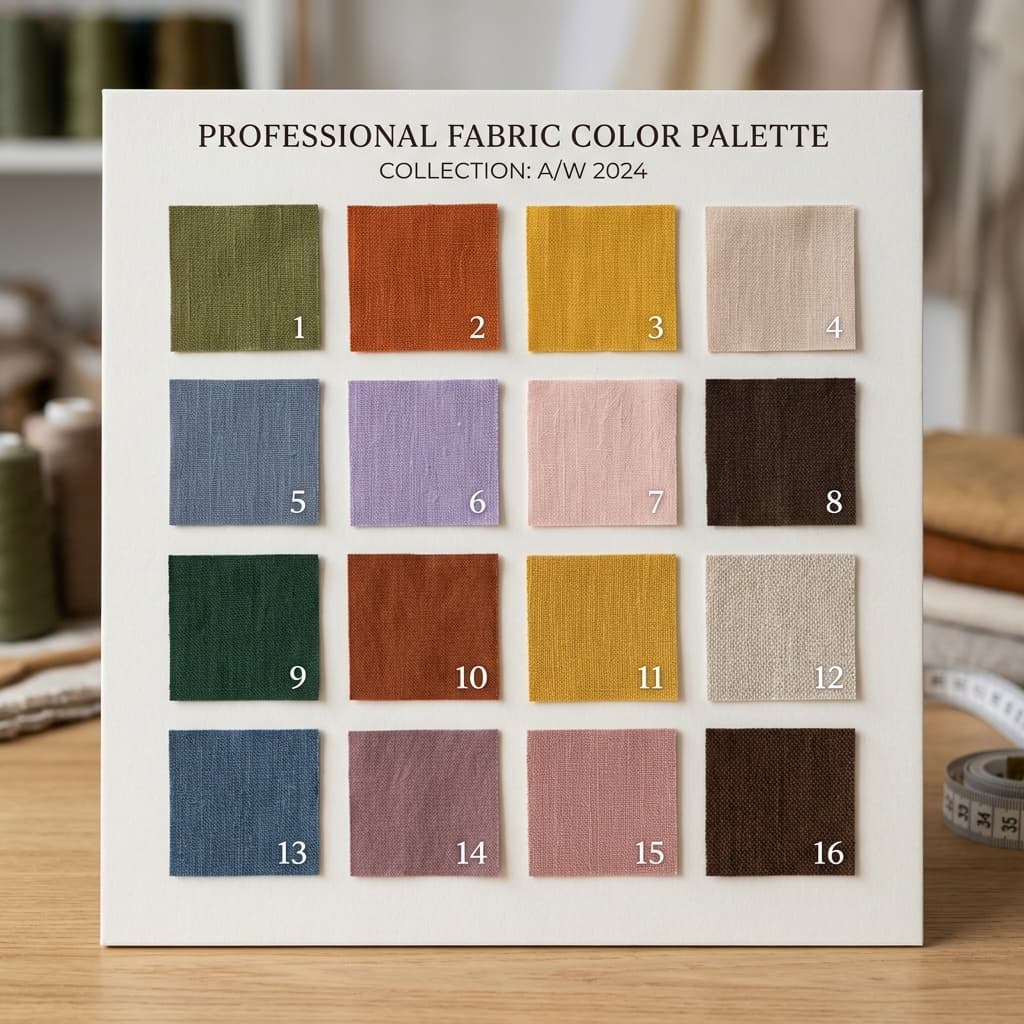
Whether swatches and custom samples are available, and whether sample approval is required before production. Being able to buy fabric swatches before committing to volume is one of the clearest signals of a transparent, authentic fabric supplier — one that lets you verify hand-feel, weight, and color on the actual material rather than on a photo or a claim.
5. Customization & Fabric Development
We can do custom dyes, digital and screen printing, GSM customisation, and finishing. People who want to be able to choose any colour should also check to see if greige fabric, which is unfinished, undyed base cloth, is available as a starting point, instead of just pre-finished stock.
6. Certifications & Compliance
GOTS, OEKO-TEX, RSL/MRSL, and social compliance documentation, current and verifiable through the issuing body, not just referenced by name.
7. Lead Times & Production Planning
Standard sampling and bulk production timelines, and how scheduling holds up during peak demand.
8. Communication & Project Management
A dedicated point of contact, how production updates are shared, and what the escalation process looks like when something goes wrong.
9. Supply Chain Transparency
Order-tracking visibility, material traceability, and how clearly documentation moves with each shipment — all directly relevant given how few brands can currently see past their direct supplier.
Buyers sourcing from India can also explore Fabric Export Trends from India in 2026: Key Insights for Global Buyers for a broader view of export capabilities, sourcing opportunities, and supply-chain considerations.
10. Commercial Reliability
Pricing transparency, payment terms, MOQ flexibility, and whether the supplier supports both a first wholesale fabric order and repeat volume without renegotiating terms from scratch each time. If a solid, pre-dyed shade is all you need, rather than a custom color match, check whether mill dyed fabric is available at the MOQ you're planning.
Weight Your Evaluation — Not Every Criterion Matters Equally
Considering every checklist item as equally significant makes it tougher to compare vendors than necessary. A weighted scorecard turns the sample looked good into an actual, auditable conclusion.
| Evaluation Area | Weight |
| Fabric Quality & Consistency | 20% |
| Manufacturing Capacity | 15% |
| Certifications & Compliance | 15% |
| Quality Assurance Process | 15% |
| Product Development & Sampling | 10% |
| Lead Time Reliability | 10% |
| Communication & Transparency | 10% |
| Commercial Terms & Flexibility | 5% |
Score each supplier 1–5 per area, multiply by weight, and total the result:
- 90–100: Preferred strategic supplier
- 75–89: Strong supplier, minor improvements needed
- 60–74: Suitable for limited or pilot orders only
- Below 60: Requires further evaluation before approval
Documents to Request Before Approving a Supplier
Beyond verbal answers to the checklist above, request these in writing before signing off:
- Company profile and manufacturing overview.
- Product catalogue and fabric specifications.
- Recent quality testing reports, where applicable.
- Certification documents (GOTS, OEKO-TEX, ISO 9001, as relevant).
- Fabric swatches and sample approvals.
- Production lead-time commitments in writing.
- Customer references or documented export experience.
Red Flags Worth Pausing Over
A single red flag doesn't automatically rule out a supplier, but a pattern of them should lead to greater due diligence before any enterprise-level commitment.
- Incomplete or unverifiable company registration details.
- Inconsistent samples across repeat requests, suggesting weak internal QC.
- Vague or shifting answers about production capacity.
- No documented inspection or AQL process.
- Reluctance to allow independent third-party inspection.
- Certificates that can't be verified through the issuing body.
- No current, contactable references.
Prove It With a Trial Order Before Scaling to Full Volume
Every check above is verification on paper. A trial order tests whether the supplier's actual process matches what they've described, under real production conditions — the step most buyers skip because they're in a hurry.
Run a trial order at a volume meaningful enough to test dye-lot consistency and inspection process — not a small swatch run. Hari Krishna supports sample yardage at no minimum order and runs trial and bulk orders through the same three-stage QA workflow, so a trial genuinely previews what enterprise-scale production would look like, rather than showing a best-case sample that bulk output won't match.
How Hari Krishna Supports Enterprise Supplier Evaluation
Enterprise buyers generally prefer working with a supplier that can support multiple stages of sourcing under one roof — fabric, dyeing, printing (screen printing, digital printing, block printing), and manufacturing — rather than coordinating separately with each, which is also where most of the visibility gaps referenced earlier actually originate.
- Wholesale fabric, first order or repeat — Hari Krishna's fabric library supports both, without renegotiating the relationship each time.
- Authentic fabric, verifiable per batch — Certification documentation is issued per batch, not as a blanket company claim.
- Buy fabric swatches before any bulk commitment — Quality, hand-feel, and color can be verified on real material before a single meter of production is scheduled.
- One QA standard, not two — The same three-stage QA workflow used for a trial order carries through to full-scale production, rather than a separate, lower-bar process for samples.
- Technical reference on request — For fabric-specific background on constructions, fibers, or finishing terms referenced anywhere in this checklist, the Fabric Wiki and Garment Wiki go deeper than a single checklist can.
Conclusion
All checks in this guide are mandatory when real volume is at stake, and each one is straightforward. The main reason for enterprise sourcing failures is often not a deceitful supplier, but a buyer who overlooked verification because the sample seemed fine, the price was appealing, and there wasn't enough time to check the business registration. Checks on legal entities, verification of capacity and validation of certificates can all be done in a matter of days. An enterprise-volume shipment failure costs a season.
If there's one step on this checklist never to compromise on, it's the trial order — every other checkpoint here gets tested for real the moment production actually runs at meaningful volume, under your terms and your inspection standard. Verify the legal entity, request the documents, run the trial order — in that order, with every new supplier, regardless of how strong the first sample looked.
FAQ
What's The Biggest Difference Between Auditing A Supplier For A Sample Order Versus An Enterprise Order?
A sample order only has to be excellent once. An enterprise order is the supplier’s entity and capacity, plus compliance documentation, to hold up at a level where one mistake costs thousands of meters, not just a handful.
How Do I Verify A Fabric Supplier's Legal Entity Before Placing A Large Order?
They pull their business registration and run it against the national registry and then ensure the invoice and payment account correspond perfectly to the registered legal name.
Should I Request A Trial Order Even If A Supplier Has Strong References?
Yes. References are for how a supplier did for somebody else. A trial order is to see how they do for your particular fabric, dye lot and inspection standard.
What AQL level should enterprise fabric orders use?
Premium garment fabric has a standard AQL of 2.5 for significant flaws and 4.0 for minor problems. For technical or luxury textiles this is generally reduced to 1.0-1.5.
Is A GOTS Or OEKO-TEX Certificate Enough Proof Of Compliance On Its Own?
No. A certificate number should always be verified independently by the issuing body — Control Union, Ecocert, OneCert, or Oregon Tilth for GOTS, and the official Label Check database for OEKO-TEX — rather than accepted as a forwarded document.
Should Every Evaluation Criterion Carry Equal Weight In A Supplier Scorecard?
No. Fabric quality, capacity, and compliance typically matter most for enterprise buyers, while commercial flexibility carries less weight — assign percentages that reflect your actual priorities before scoring suppliers.