
Inside a Bulk Fabric Order: Quality Process From Mill to Doorstep
"A bulk fabric order involves far more than producing and shipping a large quantity of material. Whether it's part of rou..."
A bulk fabric order involves far more than producing and shipping a large quantity of material. Whether it's part of routine fabric sourcing or a one-off wholesale fabric order, before fabric reaches a brand's warehouse, it typically passes through specification approval, sampling, raw-material preparation, dyeing or printing, testing, inspection, packing, and international logistics.
For a buyer, the real question isn't simply, "Can the supplier make this fabric?" It's this:
Can the supplier reproduce the approved fabric consistently at bulk volume, and deliver it in the condition promised?
This guide walks through what actually happens at each stage — from the first fabric swatch to receiving inspection — what buyers should check along the way, and where quality problems most commonly begin, whether the order is cotton, linen, denim, or knitted fabric.
Quick Answer
A well-controlled bulk fabric order follows this sequence:
Specification → Fabric swatch or sample yardage approval → Supplier capacity confirmation → Raw material (greige) check → Dyeing or printing → Laboratory testing → Fabric inspection → Packing → Shipping → Receiving inspection.
Quality should be verified at every one of these checkpoints — not just once, when the shipment lands at your warehouse. A defect caught during production is a fix. The same defect found after cutting has started is a costly write-off.
How a Bulk Fabric Order Actually Moves From Mill to Delivery

Every stage of this journey — sampling, dyeing, testing, inspection, and shipping — carries its own quality checkpoint, and each one shows up differently depending on whether you're sourcing cotton, linen, denim, or knitted fabric. The sections below walk through each of these stages in order, along with what to verify at every step and where things most often go wrong.
Stage 1: The Specification Comes Before the Fabric
The first real checkpoint in any bulk fabric order isn't a testing machine — it's the written specification.
Before production starts, the buyer and supplier need a documented agreement on:
- Fiber composition
- GSM (grams per square meter)
- Finished width
- Weave or knit construction
- Approved shade
- Shrinkage tolerance
- Colorfastness requirements
- Finishing
"Same as the sample" is not something a production floor can work from reliably. If the approved cotton fabric is 180 GSM, that figure needs to sit in the technical spec sheet with a stated tolerance (for example, ±5 GSM) — not just in an email thread.
This matters even more when a brand first discovers a fabric while buying fabric online. A product listing is useful for material discovery, but the online description is not the bulk specification. The physical sample and the technical data sheet need to be confirmed separately before a single meter goes into production.
Stage 2: Sampling — From Swatch to Production Reference
Sampling is where a buyer moves from a general fabric requirement to an actual, physical production reference.
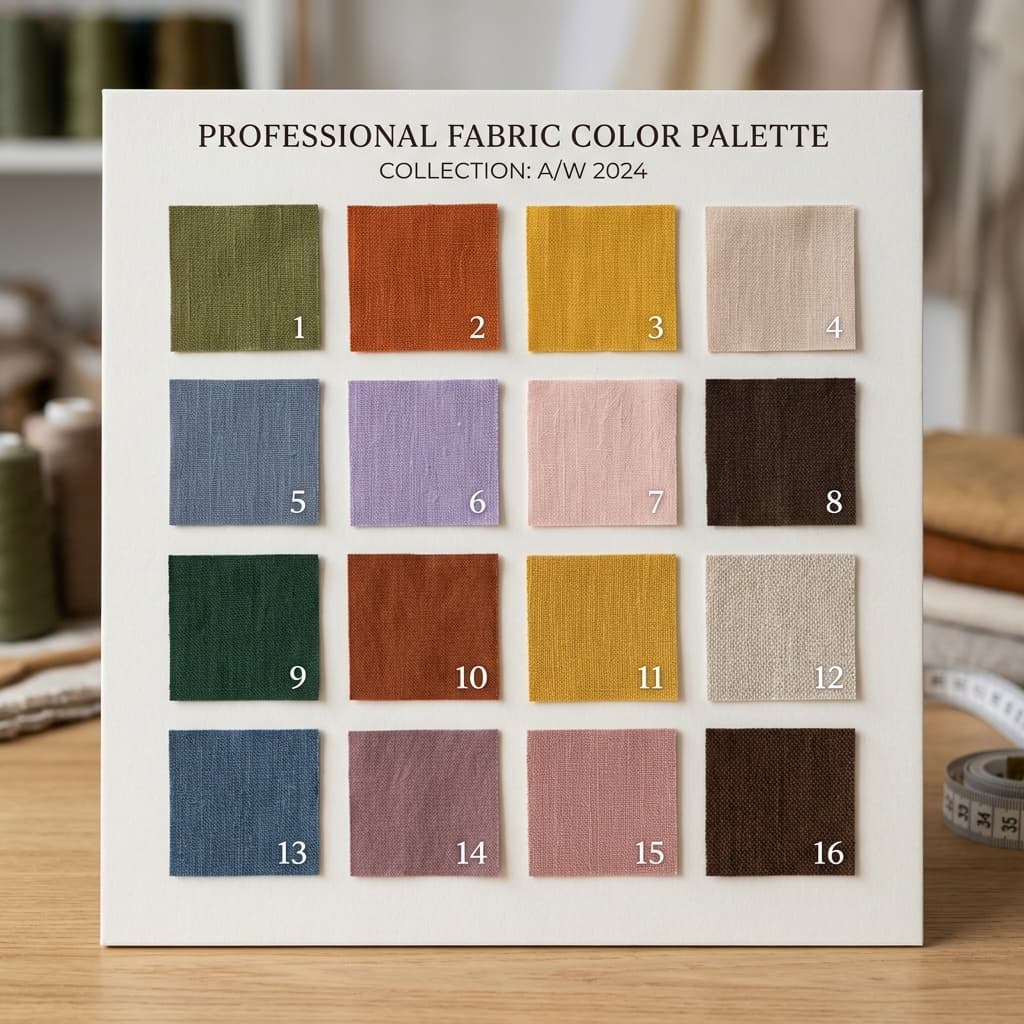
Buy fabric swatch: A brand typically starts here — a small cutting used to compare fiber, construction, weight, texture, and surface appearance across shortlisted options.
Sample yardage: Once a fabric is shortlisted, sample yardage gives a much more realistic picture of how the material will behave in actual product development — drape, hand feel, and construction at a usable length rather than a swatch-sized guess.
Dyed Sample Yardage: For dyed materials, Dyed Sample Yardage lets the buyer check the real bulk-dye shade, surface finish, and hand feel before committing to bulk dyeing.
Printed sample yardage: For printed materials, this stage lets the buyer verify:
- Artwork accuracy
- Print scale
- Repeat
- Registration
- Color reproduction
- Placement
- Hand feel
The distinction that matters:
| Stage | Purpose |
| Swatch | Initial material selection |
| Sample yardage | Production-development approval |
| Bulk order | Commercial production |
The approved sample — swatch, Dyed Sample Yardage, or printed sample yardage — becomes the physical benchmark that bulk production is measured against.
Stage 3: Supplier Confirmation and Real Production Capacity
Once the specification and sample are signed off, the supplier needs to confirm the order can actually be produced at the required volume, in the required time.
This confirmation should cover:
- Order quantity
- Raw-material availability
- Actual production capacity allocated to your order
- Expected lead time
- Dyeing or printing schedule
- Testing requirements
- Packing schedule
A supplier stating "we can produce 20,000 meters a month" doesn't mean 20,000 meters of your fabric are available next month. The more useful question is: how much of that capacity is allocated to this specific order, and when does production actually begin?
This is a critical checkpoint for clothing manufacturers, since a delay in fabric delivery pushes the entire cutting and stitching schedule downstream.
Stage 4: Raw Material and Greige Fabric
For most woven and knitted fabrics, bulk production starts before any color or finish is applied — as unfinished, loom-state material known as greige fabric.
At this stage, checks typically include:
- Yarn consistency
- GSM
- Width
- Construction
- Weaving or knitting defects
Later processing — dyeing, printing, finishing — cannot always correct a structural inconsistency that's already present in the greige stage. If construction is uneven before dyeing, that unevenness often becomes more visible, not less, once the fabric is finished. Quality control has to start before the fabric takes on its final commercial look.
Stage 5: Bulk Dyeing and Printing
Once the sample is approved, production moves into bulk processing — typically:
Pre-treatment → Dyeing or printing → Washing → Finishing
There is a big risk of dye-lot uniformity at this point. In real life, the first production lot of a 10,000-meter order of denim fabric is a little darker than the third. Each roll might look fine by itself, but clothes cut from different lots won't match if you put them next to each other on a rack.
This is handled by production teams by:
- Identifying and labeling dye lots
- Grouping similar shades together
- Separating batches with visible shade drift
- Comparing bulk output against the approved reference sample at intervals, not just at the end
The same risk applies to printed fabric - color density, registration and surface appearance can change between production runs. Different printing methods have their own dangers: It's important to keep a close eye on how the colors in digital fabric printing match up with the approved artwork when it comes to screen printing. When it comes to block fabric printing, it's even more important to make sure that the repeat placement and consistency across the roll are perfect.
(For the technical side of managing this at scale, see: Solving the Consistency Challenge in Large-Scale Fabric Dyeing and Printing.)
Quality Control Varies by Fabric Type
A single generic checklist doesn't serve every fabric equally well.
- Cotton fabric: GSM, width, shrinkage, colorfastness, construction, finishing
- Linen fabric: shrinkage, texture, width, construction, and finishing behavior after washing
- Denim fabric: shade consistency, GSM, construction, finishing, wash performance
- Knitted fabric: construction, stretch, recovery, shrinkage, dimensional stability
Example: The spec allowed for the cotton fabric is 180 GSM, but in mass manufacturing, it is regularly measuring about 195 GSM. This 15-point swing will affect garment weight, drape, fabric consumption per garment and cutting efficiency. It’s a variance that is almost noticeable on a small swatch, but a very substantial expense when you’ve cut thousands of meters.
Inspection, Testing, and Traceability
Visual inspection and laboratory testing are two separate checks. A fabric can pass one and still fail the other.
Visual Inspection
The 4-point fabric inspection system is the industry-standard method: defects like holes, stains, slubs, broken yarns, misprints, and shade variation are scored by severity, and the total score is checked against the acceptance criteria agreed with the buyer.
Laboratory Testing
Testing evaluates specific performance properties, which may include:
- Shrinkage
- Colorfastness to washing and rubbing
- Tensile strength
- Tear strength
- Pilling
- Stretch recovery, where relevant
The useful question isn't "Was the fabric tested?" It's: "Which properties were tested, against what requirement, and did the result pass?"
Roll-Level Traceability
For a large order, inspection records should trace back to individual rolls, typically including:
- Roll number
- Measured length
- GSM
- Width
- Shade
- Defect points
- Dye lot
- Production batch
If a garment manufacturer finds a problem in a section of fabric, roll-level records enable them to identify the problematic roll rather than delaying the entire order.
Verifying Organic and Sustainable Fabric Claims
Getting organic cotton fabric or any other sustainable fabric means more quality control. The fact that a seller calls something "organic" or "sustainable" doesn't prove what that claim really means.
Buyers should make sure:
- Exact fiber composition
- Applicable certification (e.g., GOTS, OEKO-TEX)
- Certification scope
- Current validity
- Documentation accompanying the shipment
For organic materials specifically, confirm the certification actually applies to the product and supply chain being purchased — not just the raw fiber. Sustainability isn't one universal label, so procurement teams need to pin down the specific environmental or material characteristic being claimed.
(For a deeper breakdown of certification verification, see: GOTS vs OEKO-TEX: A Procurement Head's Guide to Export Certification.)
Final Inspection, Packing, and the Journey to Port
Before an order leaves the supplier, final inspection should confirm the shipment matches the approved purchase order:
- Quantity against ordered meterage
- Defect levels against agreed criteria
- GSM and width
- Shade and finish
- Test reports
- Export documentation
Packing is part of the quality chain too. Rolls need protection from moisture, dust, compression, contamination, and rough handling — and each roll should stay identifiable through clear markings or accompanying documentation.
From there, the order typically moves: Factory → Domestic transport → Port → Export documentation → International transit → Customs → Final delivery.
Even if all of the production checks on a fabric order go well, it could still cause problems if the shipping documents are missing or the quantities don't match up with the paperwork.
Receiving Inspection at the Buyer's End
The quality process does not cease the moment the package arrives. A receiving check should be balanced:
Purchase order → Packing list → Roll count → Roll length → Fabric specification → Inspection records
This lets the receiving team catch missing rolls, damaged packaging, unexpected shade differences, incorrect quantities, or documentation gaps — ideally before fabric moves into cutting. Once fabric is cut and sewn, replacing or rejecting it becomes far more disruptive and expensive.
Where the Biggest Risks Actually Sit
| Stage | Common Risk |
| Specification | Unclear or incomplete requirements |
| Sampling | Wrong material or color approved |
| Greige production | Construction defects |
| Dyeing/printing | Shade variation or registration problems |
| Inspection | Defects missed |
| Testing | Performance failure |
| Packing | Damage or contamination |
| Shipping | Delays or documentation gaps |
| Receiving | Quantity or roll mismatch |
Checking at every stage isn't extra paperwork — it means catching a problem as close as possible to where it started, instead of discovering it once the material is already inside garment production.
Questions to Ask a Bulk Fabric Supplier
Before placing a major bulk fabric order, ask:
- What inspection method do you use?
- What are the acceptance criteria?
- Which fabric properties are actually tested?
- How is shade controlled across dye lots?
- How are mismatched dye lots handled?
- How is GSM verified during production?
- Can inspection and testing reports be provided?
- How are individual rolls identified?
- What happens if a bulk batch fails inspection?
The goal isn't to make the supplier generate more paperwork — it's to find out whether there's a repeatable quality system behind the production process at all.
From Fabric Quality to Garment Production
The quality of the cloth doesn't end at the fabric stage. If there is a change in GSM, width, shrinkage, building, or color, it goes straight into: Fabric → Cutting → Stitching → Finishing → Finished Garment.
If the approved spec calls for 180 GSM cotton fabric but the bulk shipment arrives noticeably heavier, that gap changes fabric consumption and garment construction — usually after the production schedule is already locked. This is exactly why fabric approval has to happen before garment manufacturing starts, not alongside it.
(For scaling this discipline beyond fabric into full production, see: How to Scale Garment Manufacturing Without Losing Quality.)
Bulk Fabric Quality Checklist
- ☐ Fabric specification documented
- ☐ Fabric swatch or sample yardage approved
- ☐ Supplier capacity confirmed
- ☐ Raw material or greige quality checked
- ☐ Dye-lot or print-batch consistency verified
- ☐ Defined fabric inspection method followed
- ☐ Required laboratory testing completed
- ☐ Organic or sustainability documentation verified where applicable
- ☐ Roll-level traceability maintained
- ☐ Shipping documentation complete
- ☐ Receiving inspection completed before cutting
Where Hari Krishna Fits Into This Process
Most buyers researching a bulk fabric order aren't just trying to understand the process — they're trying to find a fabric supplier they can actually trust with it. That's the real intent behind a guide like this: not how quality control works in theory, but who does it reliably in practice.
That's where Hari Krishna fits. It's India's all-in-one bulk fabric sourcing platform, built to handle fabric discovery, sampling, custom dyeing, digital and screen printing, block printing, laboratory testing, fabric inspection, and garment manufacturing under one roof — instead of a buyer coordinating each stage with a different vendor.
Quality is checked at the production level through proprietary SOPs covering material handling, color bleeding, shrinkage, and color accuracy — the same checkpoints this guide covers, applied consistently to every order rather than left to chance.
When a procurement team looks at a potential sourcing partner, these are the things they should ask:
- Can the required fabric actually be sourced, not just listed in a catalogue?
- Can the approved specification be reproduced reliably at bulk volume?
- Can the required quantity be delivered on your timeline?
- Can samples be evaluated properly before bulk commitment?
- Can custom colors and prints be controlled to spec, run after run?
- Can production be inspected and documented, not just promised?
- Can repeat orders be managed with the same consistency each time?
This holds whether you're sourcing cotton fabric, linen fabric, denim fabric, organic cotton fabric, knitted material, or custom dyed and printed fabric in bulk. For a deeper technical background on specific fibers and constructions, the Fabric Wiki is a useful next step rather than trying to cover every material inside a single process guide.
FAQ
What Happens After Placing A Bulk Fabric Order?
The supplier plans raw materials and production, confirms dyeing or printing requirements, processes the fabric, runs testing and inspection, packs the rolls, and arranges shipment. Quality should be checked throughout — not only at the end.
What's The Difference Between A Fabric Swatch And Sample Yardage?
A swatch is a small piece of fabric that is used to choose the material ahead of time. Sample yardage is a larger amount that is used to test color, construction, print, finishing, and performance before the bulk production starts.
How Is Fabric Quality Checked Before Bulk Shipment?
Through both visual inspection (usually the 4-point method) and testing in the lab. Testing checks for things like shrinkage, colorfastness, strength, and pilling, while inspection finds flaws and color problems.
Why Does Dye-Lot Consistency Matter?
Different dye lots can each look acceptable individually but show a visible shade mismatch when placed side by side — a serious problem when fabric from multiple lots ends up in the same garment collection.
How Can Buyers Verify Organic Or Sustainable Fabric Claims?
Make sure you know the exact fiber makeup, any certifications that apply (like GOTS or OEKO-TEX), the scope and validity of the certifications, and any supporting documents. Being "sustainable" does not guarantee a certain certification or environmental claim by itself.
Is Buying Fabric Online Enough For Bulk Qualification?
No. Online fabric discovery can help you find materials and ask for samples, but to qualify for bulk orders, you need to approve a physical sample, provide technical specifications, confirm the supplier's capacity, test the goods, and check the production process.
Conclusion
If you order a lot of fabric, the process of making it is controlled, not just one exchange from order to delivery. This is the most reliable path: Specify → Sample → Approve → Produce → Test → Inspect → Pack → Ship → Receive.
The goal isn't one final inspection — it's building multiple checkpoints to confirm the fabric still matches the approved specification as it moves from raw material to finished roll. Whether you're sourcing cotton fabric, linen fabric, denim fabric, knitted fabric, organic cotton fabric, dyed material, or printed fabric, the principle holds: the earlier a quality problem is caught, the cheaper and easier it is to fix.