
India vs. China: Lead Times & Costs for Bulk Woven Fabric Sourcing
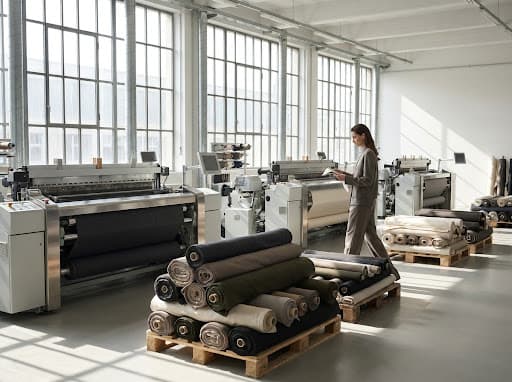
"India vs. China woven fabric sourcing is now more about your margins than your mill relationship. Both countries have se..."
India vs. China woven fabric sourcing is now more about your margins than your mill relationship. Both countries have seen their tariff policy shift three times in the last year, with India alone moving from roughly 50% US duty in mid-2025 down to under 20% by early 2026 in two separate policy changes.
For a brand ordering recurrent bulk PO’s that kind of fluctuation increases total landed cost faster than any difference in fabric quality ever could have done. This post explains genuine production lead times, MOQs and landing costs for bulk woven fabric sourcing, so US-based fashion firms and buying teams can make decisions with up-to-date numbers, not last year’s sourcing deck.
Quick Answer
India currently has the lowest total landed cost for most bulk woven fabric programs shipping to the US, while China still has a slight speed edge. Tariffs, not fabric quality, are what cause the gap.
- Effective US tariff (mid-2026): About 10–15% come from India, and 30–35% come from China (fabric-level; MFN changes by category).
- Production lead time: 4–8 weeks in both countries; China typically 10–15 days faster.
- Custom MOQ: 200–500 meters/color from India vs. 1,000–3,000+ meters/color from China (typical industry range).
- Strongest categories: India leads in cotton, linen, viscose, and sustainable fibers; China leads in polyester and technical synthetics.
- Shipping to US West Coast: ~14–34 days from China vs. ~30–40+ days from India.
Why This Comparison Has Changed
For years, sourcing teams compared India and China based on the sizes and prices of their fabrics. The choice of Textile Sourcing India vs. China now depends on trade policy first.
In August 2025, US tariffs on Indian goods went up sharply. They went from a 25% duty to a penalty tied to Russian trade, which made the actual rate about 50%. According to data from an industry survey, Indian textile exporters said that shipments to the US dropped more than 50% from one quarter to the next during that time. That got easier in two steps:
- February 6, 2026: The Russia-related penalty was lifted by a temporary agreement between the US and India, lowering the rate to about 18%.
- February 20, 2026: The Supreme Court threw out the whole system of reciprocal tariffs and replaced it with a flat 10% Section 122 rate. China's earlier Section 301 duties, which went back to 2018, stayed on top of that base.
It's important to note that the effective rate is more than just Section 122. It's Section 122 plus the base MFN duty that each country has on that type of product.
- Raw woven fabric (HTS Chapters 50–60) generally carries a lower MFN rate than finished apparel does — which is why fabric-level effective rates from India (~10–15%) run lower than the 25–35% all-in figures often quoted for finished Indian apparel and footwear.
- China's fabric-level rate still lands around 30–35% once Section 301 stacks on.
Both of these numbers could change even more because, as of mid-2026, a separate USTR review of Indian supply-chain compliance was still going on.
India vs. China: Lead Time Comparison
Not only does the country affect production speed, but also the type of fabric, any customisations, and the size of the order. The table below shows typical industry ranges for orders of woven fabric that are made to order.
| Stage | India | China |
| Sampling & development | 1–2 weeks | 1–2 weeks |
| Weaving, dyeing, finishing | 4–8 weeks | 4–8 weeks, ~10–15 days faster on average |
| Bulk production scheduling | Strong at scale; more mill coordination on complex orders | Strong at scale; tighter scheduling via integrated clusters |
| Ocean freight to US West Coast | ~30–40+ days | ~14–34 days |
| Ocean freight to US East Coast | ~35–50 days | ~30–50 days |
Bottom line: China does have a small speed advantage—usually two to three weeks when shipping is added in. Often, that gap is smaller than the cost of moving suppliers in the middle of a large-scale program that happens over and over again.
India vs. China: Cost & Tariff Comparison
The FOB price of fabric in both countries is usually pretty close. The real difference in price shows up after customs, not before.
| Cost Factor | India | China |
| FOB price, basic 160gsm cotton woven | $3–5/meter (typical range) | $3–5/meter (typical range) |
| Effective US tariff, woven fabric (mid-2026) | ~10–15% | ~30–35% |
| Tariff cost on a $100,000 FOB order | ~$10,000–15,000 | ~$30,000–35,000 |
| Strongest fiber category on cost | Cotton, linen, viscose | Polyester, technical synthetics |
This gap gets bigger every time a bulk fabric sourcing tool places the same order twice. When the program is repeated, the difference in tariffs usually makes up for a slightly lower China FOB price.
MOQ Comparison
Inventory risk and the number of colourways a brand can try out before going big are both affected by the minimum order amount. MOQs are different for each mill and type of fabric, but the design below is something that you can use to compare most woven fabric suppliers.
- India: Custom woven fabric typically starts at 200–500 meters per color.
- China: Custom woven fabric typically starts at 1,000–3,000+ meters per color (typical industry range; individual mills vary).
- Both countries: Support bulk production of 5,000–20,000+ meters/month at scale.
Where Each Country Leads on Fabric Type
Most of the time, the type of fibre is what makes the difference, before cost or wait time even come up.
India leads in:
- Cotton, including organic and GOTS-certified options
- Linen and other natural fibers
- Viscose and rayon
- Sustainable and certified fabrics (OEKO-TEX, GOTS)
China leads in:
- Polyester and other synthetic wovens
- Technical and performance textiles
- High-volume, standardized blended fabrics
Hidden Costs Buyers Often Miss
The price of the fabric rarely shows how much it cost to get it. These things change the real number more than most people think they will.
- Tariff misclassification: Confusing fabric (HTS Ch. 50–60) with apparel (Ch. 61–62) codes can shift duty by 15+ points.
- Sampling revisions: Multiple colorway rounds add weeks before a bulk PO is placed.
- Transshipment delays: India's shipping routes more often transship, adding time not shown in quoted transit windows.
- Compliance documentation: Increased US customs scrutiny on fiber traceability can hold undocumented shipments.
The China+1 Approach Most Brands Are Taking
Not many brands are leaving one country for another. Instead, most are splitting their sourcing by fabric type, which is a trend that is sometimes called China+1.
- China is still the place to get synthetic and technical fabrics because of its low costs and large-scale production.
- The linen, viscose, and cotton fabric sourcing programs move to India, which is a good place for them because of its low tariffs and large domestic fibre base.
- Tariff savings grow with each repeat order, so recurring bulk programs benefit the most.
Sourcing From India: What US Buyers Should Confirm
Any comparison that depends on place needs to be checked for location. Before committing to a seller, people who want to buy woven fabric from India for the US market should make sure of a few things.
- Check the effective tariff rate for the exact HTS classification right now, not a rate that was given earlier in the year.
- Check with the supplier to see if they keep records of fibre traceability and certification (GOTS, OEKO-TEX).
- Make it clear if the MOQ is for each colour or each style, as this changes the size of the whole order.
- Ensure there is cut-and-sew handoff help if the fabric needs to go to a clothing manufacturer next.
Hari Krishna: A Faster Way to Source Bulk Woven Fabric From India
When brands move their bulk woven fabric sourcing from China to India, they need a partner who can take care of the coordination between multiple vendors that slows down orders from India.
This is exactly what Hari Krishna was made for. As a tech-enabled, full-stack production partner, it combines sourcing, dyeing, printing such as screen printing, digital printing and block printing, and manufacturing into a single environment, rather than a bunch of separate vendors. It also offers end-to-end order lifecycle automation, which lets you see the whole process, from sampling to shipping in bulk.
These are the brands that can:
- Huge fabrics — Cotton, linen, viscose, silk, and sustainable fabric options including Organic Cotton, TENCEL™, EcoVero™, and Modal.
- A verified manufacturing network built on 10+ years of dyeing and printing expertise.
- Manufacturing scale from low-MOQ sampling to mass production programs of 20,000 meters a month, with multi-million-meter capabilities for bigger recurring orders.
- Order-lifecycle visibility across sampling, dyeing, printing, and production, keeping quality and lead times consistent as volume scales.
- A base of 500+ fashion brands and businesses currently sourcing through Hari Krishna, from initial development through enterprise-scale production.
What this means for a bulk buyer, day to day:
- Verified fabric authenticity and consistent bulk quality, order after order.
- Optimized, predictable lead times instead of the multi-vendor delays common in fragmented India sourcing.
- Low MOQ with scalable production, so a design can be tested before it's committed to at volume.
- Transparent, efficient pricing with no hidden coordination costs.
- Technology supported by human textile expertise — automation for visibility, real sourcing specialists for judgment calls.
Conclusion
India has the higher landing cost for most bulk woven fabric sourcing programs that ship to the US right now. This is especially true for cotton, linen, and viscose, where India's fabric-level tariff is about a third of China's. China still has a small advantage in terms of production and shipping speed, and it is still the best place to get polyester and advanced synthetics on a large scale.
In every category, neither India nor China wins, and both countries' tariff rates have changed more than once in the past year. The specific HTS classification and order recurrence are more important than a general India vs. China rule. Check to see what the current prices are for your goods, and then [ask Hari Krishna for a sample-to-bulk quote] so you can compare the landed cost to your current China program.
FAQ
Is India Or China Cheaper For Bulk Woven Fabric Sourcing?
India for most of the packages going to the US. As of mid-2026, its effective fabric-level tariff is about 10–15%, while China's is 30–35%. This is higher than China's comparable or slightly lower FOB prices.
Which Country Has Shorter Lead Times?
By a small amount—production is usually 10–15 days faster in China, and the ocean route to the US West Coast is shorter. Usually, the difference is two to three weeks.
What's The Minimum Order For Woven Fabric From India?
Custom-woven cloth usually starts at 100–500 meters per colour, which is less than the 1,000–3,000 meters or more that Chinese mills usually need for custom orders.
Does India Offer Sustainable And Certified Woven Fabric?
Yes. Along with its well-established natural fibre industry, India has a strong and growing base of GOTS-certified organic cotton and OEKO-TEX-certified fabric choices.
Are The Tariff Rates In This Article Stable?
No, rates have changed more than once in the last year for both countries. Before you finalise a big purchase order, make sure you know the current rates for your HTS classification.
Can I Test A Design Before Placing A Bulk Order?
Yes. Most fabric providers in India, like Hari Krishna, allow for small sample runs before going into full-scale production. This lowers the risk of trying out a new colourway or construction.